EDR solutions ensure an organization's endpoints are running properly by monitoring and troubleshooting tech on the network. Compare the top tools now.
Twitch streamer Kai Cenat was swatted during a live stream, shocking viewers. The event unfolded mid-stream, highlighting the risks streamers face from hoaxes.
Navy Warship USS Manchester Installed Starlink for Illegal Wi-Fi Connection
Military officials installed Starlink on a Navy warship, not for operations but to provide high-speed internet for sports and Netflix. Watch to learn more.
Video: Hackers Bypass TSA Security with SQL Injection
We reveal a TSA security flaw that allowed hackers to bypass protocols and access cockpits. Explore the implications of this breach and what can be done.
EDR solutions ensure an organization's endpoints are running properly by monitoring and troubleshooting tech on the network. Compare the top tools now.
Twitch streamer Kai Cenat was swatted during a live stream, shocking viewers. The event unfolded mid-stream, highlighting the risks streamers face from hoaxes.
Navy Warship USS Manchester Installed Starlink for Illegal Wi-Fi Connection
Military officials installed Starlink on a Navy warship, not for operations but to provide high-speed internet for sports and Netflix. Watch to learn more.
Video: Hackers Bypass TSA Security with SQL Injection
We reveal a TSA security flaw that allowed hackers to bypass protocols and access cockpits. Explore the implications of this breach and what can be done.
What Is Security Service Edge (SSE): All You Need to Know
Learn how Security Service Edge (SSE) works, its benefits, key components, use cases, and why it matters for securing modern hybrid and cloud environments.
eSecurity Planet content and product recommendations are
editorially independent. We may make money when you click on links
to our partners.
Learn More
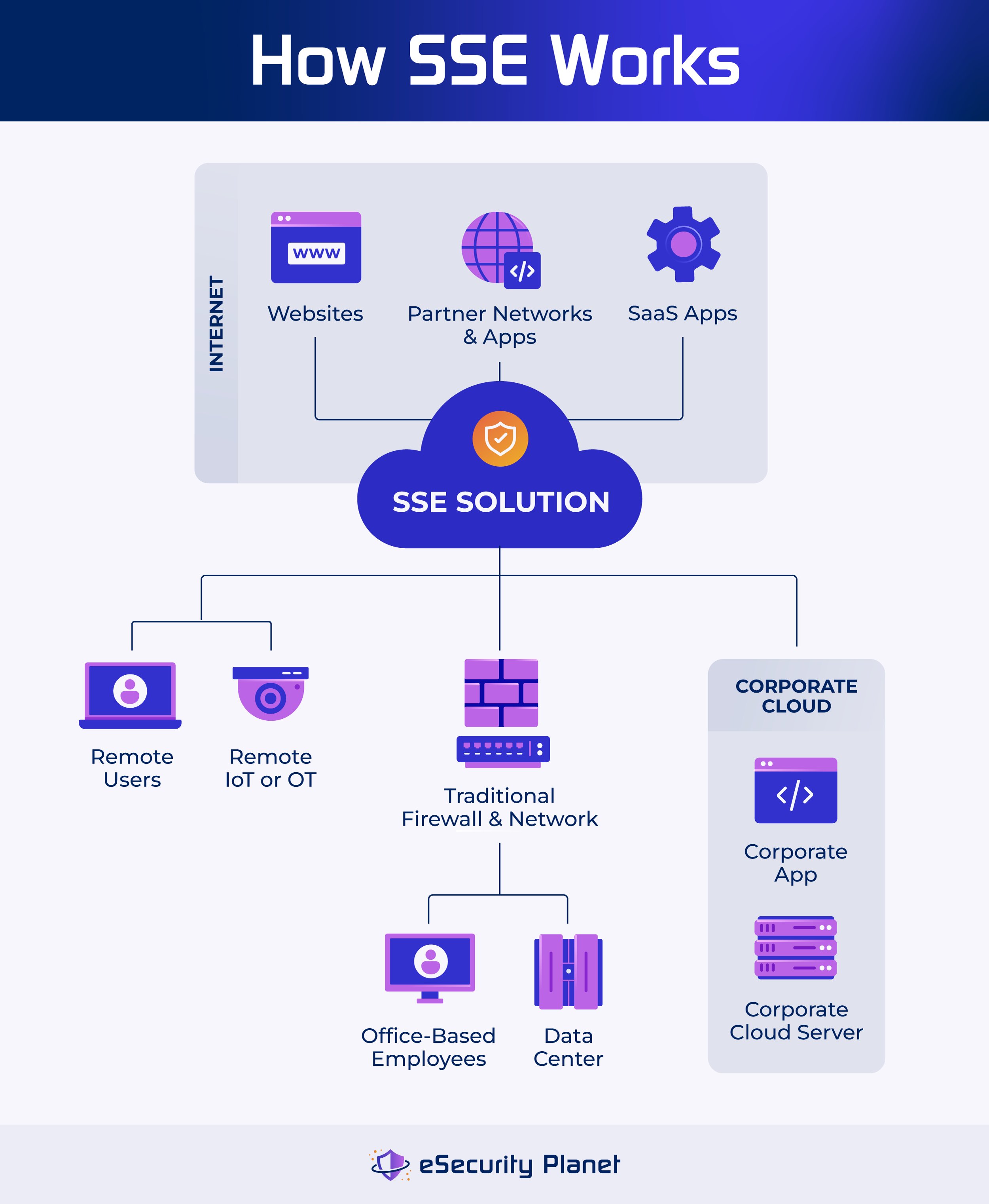
Security Service Edge (SSE) is a cloud-delivered security framework designed to secure access to web destinations, SaaS applications, and private business applications — no matter where users or devices operate.
As organizations shift toward hybrid work and cloud-first environments, SSE provides the scalable, unified controls needed to protect users and data beyond the traditional corporate perimeter.
This article explains how SSE works, the core capabilities, the benefits and challenges, use cases, and the major trends shaping SSE adoption.
SSE places a cloud-based security control layer between users and the applications or websites they access. Instead of routing traffic back through on-premises VPNs or firewalls, SSE evaluates access requests in the cloud and applies consistent security policies regardless of location, device, or network.
This approach addresses today’s reality:
Traditional VPN-centric models create congestion, degrade user experience, and lead users to bypass security tools altogether.
Many organizations now manage more than 1,500 applications, spanning SaaS and internally developed tools.
Nearly half of employees work remotely or in hybrid roles.
Network traffic increasingly flows directly to cloud services rather than through corporate data centers.
By delivering inspection, access control, and threat protection at the edge, SSE enables secure, direct-to-cloud connectivity without sacrificing performance.
Advertisement
SSE vs. SASE vs. VPNs: What’s the Difference?
Security Service Edge (SSE) is a cloud-delivered security layer that provides ZTNA, SWG, CASB, FWaaS, and DLP to secure user access to applications, SaaS, and the web. It focuses on security controls rather than network transport and is designed for hybrid work and cloud-first environments.
Secure Access Service Edge (SASE) includes everything in SSE plus SD-WAN networking capabilities. While SSE handles the security stack, SASE converges networking and security into a single cloud-based architecture. SSE can be adopted on its own, or as a stepping stone toward full SASE.
Virtual Private Networks (VPNs) are legacy remote access tools that create a secure tunnel back to a corporate network. VPNs grant broad network-level access, often cause performance bottlenecks, and do not scale well for hybrid or SaaS-heavy environments. In contrast, SSE provides application-level zero-trust access, cloud-native performance, and consistent inspection without forcing traffic through the data center.
Advertisement
Key Components & Capabilities of SSE
An effective SSE platform integrates several cloud-native security services that work together to control access, monitor behavior, protect data, and defend against threats.
Zero Trust Network Access (ZTNA)
ZTNA replaces broad, network-level VPN access with identity-based and context-based controls. Users are granted access only to the specific applications they are authorized to use. This reduces lateral movement risk and supports modern least-privilege access models.
Organizations increasingly require ZTNA solutions that support not only web-based applications but also internal, non-web protocols — an area where many traditional remote access tools fall short.
Advertisement
Cloud Access Security Broker (CASB)
CASB provides visibility and control over SaaS usage. It enforces security policies around authentication, data access, data sharing, and shadow IT.
Secure Web Gateway (SWG)
SWG filters and inspects web traffic to enforce acceptable use policies and block malicious sites, phishing attempts, or harmful downloads.
Firewall-as-a-Service (FWaaS)
FWaaS delivers cloud-based traffic inspection and filtering, replacing or augmenting on-premises firewalls. It applies consistent threat protection across all user traffic, regardless of location.
Data Loss Prevention (DLP)
DLP identifies sensitive data and prevents unauthorized transmission or exfiltration. Integrated DLP is increasingly essential given the expanded attack surface introduced by cloud adoption and remote work.
Advertisement
Why Organizations Are Turning to SSE
Organizations today face mounting security and operational pressures. Several trends are accelerating SSE adoption.
Growing Complexity Across IT and Security
Many organizations describe their environment as complex or extremely complex. Contributing factors include:
The rapid expansion of cloud applications
A fragmented security stack averaging 63 different security tools
Remote and third-party access requirements
Implementation of least-privilege access policies
Strain on User Experience
A portion of remote users report dissatisfaction with current access methods, often due to:
Repeated authentication requests
Slow or unreliable VPN connections
Multiple steps required to reach applications
As a result, users have bypassed recommended VPN tools, increasing security risk.
Operational Inefficiencies
Managing distributed security appliances and legacy VPN infrastructures is costly and complex.
Organizations often prefer:
A single cloud-native service
Unified policy creation and reporting
Reduced hardware procurement and maintenance
Escalating Risk Exposure
Remote and hybrid work has materially expanded the attack surface:
Cisco and ESG found that 44% of cyberattacks now originate from remote/hybrid users and devices.
Many organizations consider these users their highest-risk group.
Early SSE adopters have reported a 25% reduction in security incidents after implementation.
Advertisement
Primary Benefits of SSE
Improved Security for Remote Users
SSE enforces consistent inspection and access control for all traffic, closing gaps created when users bypass VPNs or access SaaS apps directly.
Enhanced Network Performance
By eliminating the need to backhaul traffic through a data center, SSE reduces latency and improves the experience for cloud and web applications.
Reduced Tool Sprawl and Complexity
Converging multiple security functions into a unified cloud service simplifies management, strengthens policy consistency, and reduces operational overhead.
SSE provides centralized insight into user behavior, data movement, and application access, helping organizations detect and respond to risks earlier.
Advertisement
Common Challenges of SSE
Even with significant benefits, organizations may encounter challenges with SSE, including:
Integration gaps between legacy tools and modern SSE platforms
Architectural misalignment when trying to retrofit SSE into outdated network models
Policy redesign requirements for zero trust access and cloud-first workflows
Concerns about cloud-based inspection in highly regulated environments
User adoption friction, especially when workflows or access patterns change
With proper planning, these challenges are manageable, but they require cross-functional coordination.
SSE Use Cases & Applications
Eliminating VPN Congestion
Organizations streaming high-bandwidth workloads — such as video or large file transfers — benefit from direct, secure cloud access without VPN bottlenecks.
Securing Global OT Environments
Distributed sensors and IoT devices can securely transmit data to cloud analytics platforms without relying on fragile on-premises networks.
Improving Healthcare Access
Medical professionals gain faster, safer access to email, imaging systems, and patient applications with built-in malware defense and simplified login experiences.
Safely Viewing High-Risk Files
Remote browser isolation allows HR teams to open resumes and attachments securely without risking endpoint compromise.
Protecting SaaS Access for Distributed Teams
Sales, customer success, and support teams can access tools like Salesforce and Box securely, with controls preventing data theft or unauthorized downloads.
Advertisement
Top SSE Vendors
When selecting an SSE solution, organizations often evaluate leading vendors recognized for cloud-native architectures and strong ZTNA, SWG, CASB, and FWaaS capabilities.
Cisco: A Leader in SSE, Cisco Secure Access delivers a unified, cloud-native platform combining SWG, CASB, ZTNA, and FWaaS with advanced threat intelligence and integrated tools like DEM, RBI, and VPN-as-a-Service for non-web applications.
Fortinet: The only vendor in the Challenger quadrant, FortiSASE also includes SD-WAN and builds off of their next-generation firewalls for strong packet filtering.
Lookout: Positioned in the Visionary quadrant, Lookout delivers fast-to-deploy SSE with strong data protection features and integrated SWG and CASB capabilities.
Netskope: A Leader in the SSE quadrant, Netskope operates a private cloud network in 70+ regions and provides robust ZTNA and data protection capabilities.
Palo Alto Networks: Prisma Access earns a Leader position by combining strong ZTNA and firewall capabilities with cloud-delivered security built on Palo Alto’s broader SASE platform.
Skyhigh Security: A Visionary in the SSE quadrant, Skyhigh emphasizes data protection with features like Remote Browser Isolation and advanced DLP controls.
Zscaler: Consistently ranked as a Leader, Zscaler’s cloud-first architecture and built-in zero-trust capabilities secure access to a wide range of applications and environments.
Vendor selection typically depends on performance needs, data protection maturity, global presence, and required integrations.
Advertisement
SSE Trends to Watch
Stronger ZTNA Support for All Application Types
Modern ZTNA must support web and non-web protocols to fully replace VPNs.
Consolidation Through SASE
More organizations are combining SSE with SD-WAN to build holistic SASE architectures.
Rising Focus on User Experience
Organizations increasingly evaluate SSE based on UX metrics like access friction, latency, and user satisfaction.
Hybrid Work as the Default
With remote and hybrid work at scale, secure access from anywhere is no longer optional.
AI-Powered Detection and Policy Automation
Vendors are integrating AI to detect anomalies, reduce false positives, and streamline incident response.
Advertisement
Bottom Line: SSE Is Essential for the Modern Enterprise
As cloud adoption accelerates and hybrid work becomes the norm, traditional perimeter-based security can no longer keep up with the demands of modern enterprises. SSE offers a unified, cloud-native framework that improves security, enhances performance, simplifies operations, and delivers a seamless experience for end users.
Ken Underhill is an award-winning cybersecurity professional, bestselling author, and seasoned IT professional. He holds a graduate degree in cybersecurity and information assurance from Western Governors University and brings years of hands-on experience to the field.
Open-source vulnerability scanners identify security vulnerabilities in apps, networks, and systems. Compare features and functionalities with our guide.
eSecurity Planet is a leading resource for IT professionals at large enterprises who are actively researching cybersecurity vendors and latest trends. eSecurity Planet focuses on providing instruction for how to approach common security challenges, as well as informational deep-dives about advanced cybersecurity topics.
Advertiser Disclosure: Some of the products that appear on
this site are from companies from which TechnologyAdvice
receives compensation. This compensation may impact how and
where products appear on this site including, for example,
the order in which they appear. TechnologyAdvice does not
include all companies or all types of products available in
the marketplace.